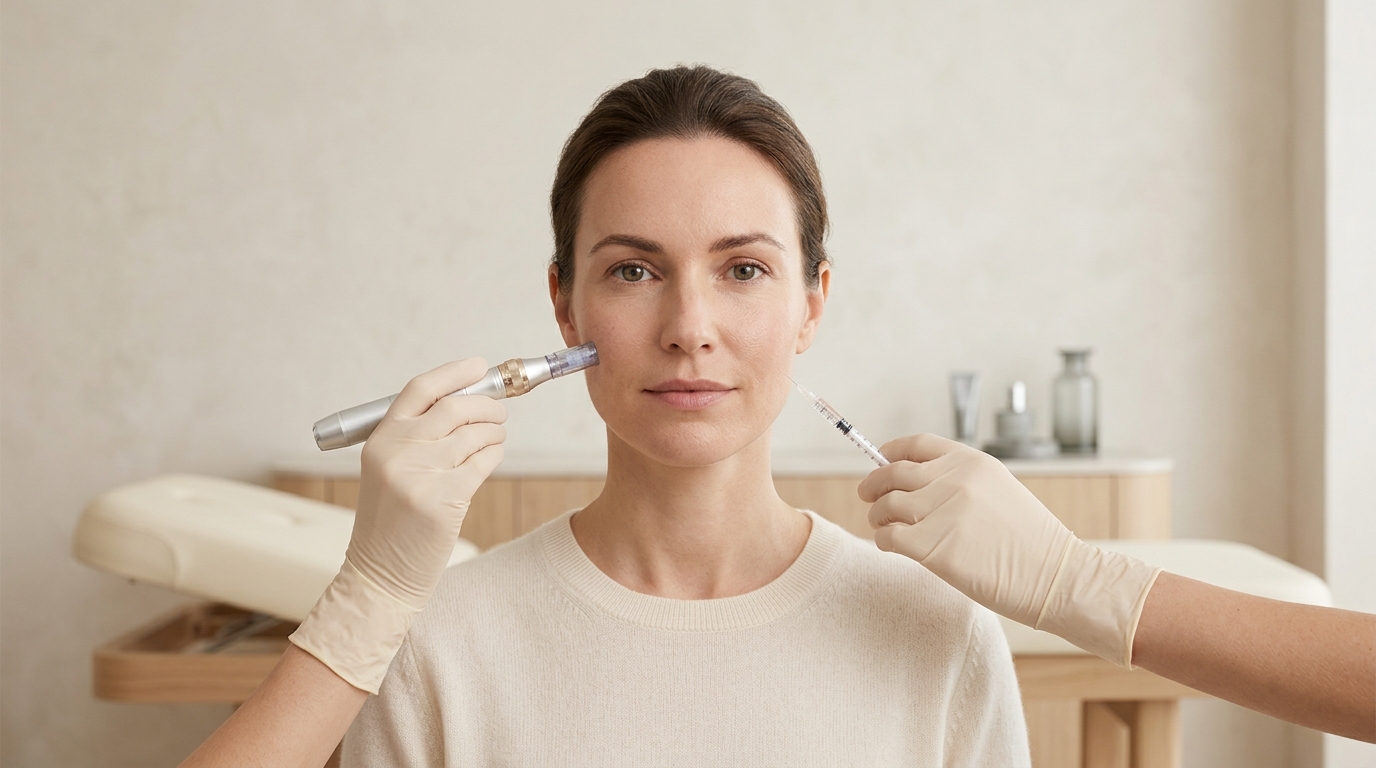
If you want to improve your skin, you’ll quickly come across various treatments. Two that are becoming increasingly popular are polynucleotides and microneedling. Both focus on skin improvement and can be used for concerns such as fine lines and skin that looks less fresh or even. Yet they work in very different ways.
With a polynucleotide treatment, polynucleotides are injected into the skin. At Amsterdam Skin Clinic, we use Rejuran for this. Microneedling, on the other hand, works by stimulating the skin in a controlled way with very fine needles.
Which treatment suits you best therefore depends not only on what you want to improve, but also on your skin condition and the cause of your skin concern.
What is the difference between polynucleotides and microneedling?
The main difference lies in how the two treatments work.
With polynucleotides, a product containing purified DNA fragments from salmon is injected into the skin. The treatment aims to support processes involved in skin repair, hydration, elasticity and collagen production. At Amsterdam Skin Clinic, we use Rejuran for this.
With microneedling, no polynucleotide product is injected. Fine needles create controlled micro-channels in the skin. This activates the skin’s natural healing process and stimulates collagen production and remodelling.
Both treatments aim to improve the skin, but they do so in different ways.
When do you choose polynucleotides?
A polynucleotide treatment can be a good option when the focus is mainly on improving overall skin quality.
Think of skin that feels drier or less elastic, early fine lines or skin that has lost some of its fresh appearance. Polynucleotides don’t add volume the way a filler does. The aim is rather to gradually improve the quality of your existing skin.
This fits the wider trend in cosmetic treatments, where more and more attention goes to skin quality and natural-looking results, rather than just adding volume.
Scientific interest in polynucleotides is growing too. According to a systematic review of polynucleotides in aesthetic medicine, several studies showed improvements in skin texture, elasticity and fine lines, among other things. At the same time, the researchers stress that the available research is still relatively limited and that larger, higher-quality studies are needed.
We think that last point is important: polynucleotides are promising, but realistic expectations and a proper assessment of whether the treatment suits you remain essential.
When do you choose microneedling?
A microneedling treatment is often the more obvious choice when skin texture and skin renewal are the main focus.
Microneedling can be used for:
- uneven skin texture;
- enlarged pores;
- fine lines;
- pigmentation;
- certain types of acne scars.
The controlled micro-channels trigger a healing response in the skin. This activates processes involved in the production of new collagen and the renewal of skin texture.
Microneedling has been studied extensively, especially for atrophic acne scars. According to a systematic review of microneedling for acne scars, the studies reviewed showed an improvement in the appearance of acne scars, although the right treatment still depends on the type of scar and the individual skin.
If your main concern is visible skin texture or acne scars, microneedling is therefore more likely to be considered than polynucleotides.
Polynucleotides or microneedling for fine lines?
For fine lines, the distinction is less clear-cut, as both treatments can be considered. That’s why we don’t just look at the lines themselves.
If fine lines go hand in hand with dry, thin or less elastic skin, polynucleotides can be a good option because the treatment focuses on overall skin quality.
If the fine lines come with a rougher or uneven skin texture, microneedling may be a better fit.
Location also plays a role. The skin around the eyes, for example, is much thinner than the skin on the cheeks. That’s why the Rejuran range also includes specific applications for the eye area.
So the better question isn’t just: which treatment works against fine lines?
But rather: why are the lines visible, and which aspect of the skin do we want to improve?
What works better for acne scars?
For visible acne scars, microneedling is usually considered first. That’s because microneedling directly aims to stimulate skin remodelling, and there is relatively extensive research on its use for atrophic acne scars.
It is important, however, to distinguish between different types of acne scars. A superficial scar doesn’t automatically call for the same treatment as a deep scar.
During a skin analysis, we therefore first look at the type of scar, its depth and the condition of the surrounding skin before giving treatment advice.
Polynucleotides can target skin quality, but we wouldn’t present them simply as a replacement for microneedling for every type of acne scar.
What works better for dry or less elastic skin?
When the skin mainly feels dry, thin or less resilient, polynucleotides may actually be the more interesting option.
Rejuran is injected into the skin and targets processes involved in hydration, elasticity and skin quality, among other things.
Microneedling can also contribute to skin improvement, but works through a different route: stimulating the skin in a controlled way to trigger a healing response.
That’s why someone with dry, delicate skin may receive different treatment advice than someone with thicker skin where texture and scarring play the main role.
What about recovery after both treatments?
The treatments also differ in terms of recovery.
After a polynucleotide treatment, small bumps may be temporarily visible at the injection sites. Mild redness, swelling, sensitivity or a small bruise may also occur. This usually fades on its own.
After microneedling, the skin often looks red for a while and may feel slightly warm or sensitive. In the days that follow, the skin may be drier or flake slightly.
How strong the reaction is and how long it lasts differs per person and also depends on the treatment area and the intensity of the treatment.
Do you have an important occasion coming up? Discuss this with your practitioner in advance, so enough recovery time can be planned in.
Can you combine polynucleotides and microneedling?
In some cases, yes, but that doesn’t automatically mean both treatments are needed at the same time.
Because polynucleotides and microneedling work through different mechanisms, they can sometimes be used alongside each other as part of a broader treatment plan. For example, when both skin quality and skin texture need attention.
The order and the time between treatments do need to be tailored to the skin and the desired result.
More treatment isn’t automatically better. Sometimes one treatment fits your skin goal perfectly and a combination isn’t needed at all.
So: polynucleotides or microneedling?
There is no treatment that is better for everyone.
If you mainly want to work on skin texture, enlarged pores or certain acne scars, microneedling can be a logical choice.
If the focus is more on skin quality, hydration, elasticity and fine lines without adding volume, polynucleotides such as Rejuran may be the better option.
And sometimes the goals overlap. That’s exactly when it’s important not to choose based on a treatment name or trend alone.
At Amsterdam Skin Clinic, we first look at your skin condition and what you want to improve. Based on that, we can determine whether polynucleotides, microneedling or another treatment best suits your skin.
Want to know which treatment suits your skin best? Book a free, no-obligation consultation at Amsterdam Skin Clinic.